<= Back to Home
K-ToBI
(Korean ToBI) Labelling Conventions
(version 3.1, in November 2000)
Sun-Ah Jun
Dept. of Linguistics , UCLA
1. Background
K-ToBI (Korean TOnes and Break Indices) is a prosodic transcription
convention for standard (
1.1 Intonational structure of
The intonational structure of the standard dialect (=

Figure 1. Intonational Structure of
IP: Intonation Phrase, AP: Accentual Phrase
w: phonological word, s: syllable
T= H, when the syllable initial segment is
aspirated/tense, otherwise, T= L
%: Intonation phrase boundary tone
An IP can have one or more APs, which in turn can have one or more Phonological words, W. An IP is marked by a boundary tone at the end, but not the beginning, of an IP, and delivers various pragmatic meanings as well as information about the sentence type. The boundary tone is realized in the IP final syllable, and depending on the shape of f0 contour starting from the onset of the IP final syllable, at least nine boundary tones have been identified (L%, H%, LH%, HL%, LHL%, HLH%, HLHL%, LHLH%, LHLHL%). For example, H% and LH% differ in the timing of rising; LH% rises later than H%, showing a f0 valley at the beginning of the IP final syllable. The same is true with HL% vs. LHL% or HLH% vs. LHLH%. In general, tones ending with H% often have a function of seeking information (i.e. question) and those ending with L% often have a function of making a statement. However, it is often the case that tones and meaning have many-to-many relationship. That is, more than one boundary tone can be used to mark the same meaning or sentence type, and more than one meaning is realized by the same boundary tone. For example, a wh-question can be marked by L%, H%, LH%, HL%, or HLH% (see Jun & Oh 1996), and HL% marks both a declarative and a wh-question. More research is needed to identify distinctive pragmatic meaning for each boundary tone.
2. Structure of K-ToBI
The original ToBI system (i.e., English ToBI) has four parallel tiers (word, tone, break-index, and miscellaneous), but allows the free proliferation of site-specific extra tiers. Sites with aligner for English, for example, have generally added a phones tier for phonetic segmentation, and J_ToBI users have agreed to add an obligatory “finality” tier where intonational phrases that sound “final” to a discourse turn taking are minimally marked as such (until they can develop a more complete discourse model of discourse finality to govern a hierarchy of labels for this tier). In accordance with this general design principle, the current version of K-ToBI expands a tone tier into two tiers, a phonological tone tier and a phonetic tone tier, in order to describe surface tonal patterns which are not predictable from the underlying tones. Therefore, a K-ToBI transcription for an utterance consists minimally of a recording of the speech, an associated record of the fundamental frequency contour, and the transcription-proper symbolic labels for events on the following five parallel tiers:
1.
a word tier
2. a phonological tone tier
3. a phonetic tone tier
4. a break-index tier
5. a miscellaneous tier
2.1 Motivation of revision
The expansion of the tone tier was devised
to label the surface tonal pattern of an accentual phrase (= AP) separately
from the underlying tones marking the AP boundary. This was motivated by
the following four reasons. First, the ToBI labeling system assumes that
tones are labeled only when they are distinctive (Beckman & Ayers 1994, http://ling.ohio-state.edu/~tobi/).
Non-distinctive pitch events that are automatically extractable from the signal
should not be labeled. This is true for English ToBI. However, in
Korean, distinctive pitch events do not come from an individual phrasal tone
but as a set of tones forming an AP. Furthermore, though the most common
tone pattern of an AP is LHLH or HHLH when the AP is longer than three
syllables, an AP in Seoul Korean can be realized in at least fourteen different
tonal patterns, with more variation when the AP has fewer than three syllables
(i.e., LH, LHH, LLH, LHLH, HH, HLH, HHLH, LL, HL, LHL, HHL, HLL, LHLL,
HHLL). Though these various patterns do not seem to differ in meaning
among themselves, and though they do not seems to be predictable, it is not yet
known if all these variations are indeed neither distinctive nor
predictable. By labelling surface tonal patterns, we will be able to
investigate if there is any meaning difference among these patterns.
Second, the earlier version
of K-ToBI labels only two types of tones for an AP: ‘H-’ marking an
AP initial H tone, when realized, and ‘LHa’ marking the end of an
AP. When there is no initial H in an AP, H- was not labelled, conforming
to the surface realization. However, in the rare event that an AP-like
phrase ends in an L tone, that tone was labelled ‘L%’ instead
of ‘La’ since a phrase final L tone was found at IP final position
most of the time and we did not want to increase the tonal inventory of AP
without enough evidence. Then, in order to indicate that the AP-like
boundary juncture does not match the tone pattern, a break index
‘2m’ was placed on a break index tier: the degree of juncture is
the same as that of the usual AP boundary, i.e., ‘2’, but the tonal
mark, L%, shows the boundary of an Intonation Phrase. Sometimes this was
indeed the case. However, observation of more natural data revealed that
there are AP boundaries which are sometimes realized in an L tone due to the
tonal interaction of adjacent tones and stylistic variations. At the
moment, the detailed condition of an AP final L tone and its pragmatic meaning
are not known. We hope to get answers to these issues by labelling a
falling AP boundary as ‘La’ on the phonetic tone tier.
By allowing ‘La’
to mark an AP boundary, this revised version now has a different definition of
the break index ‘2m’. Before, it was used for a mismatch
between tone and break index covering two cases: “2-like break but not
AP-like tone” and “AP-like tone but not 2-like break”. In
the current version, a break index ‘2m’ refers only to the former:
“2-like break but not AP-like tone”. “AP-like tone but
not 2-like break” will be labelled in two ways depending on the degree of
perceived juncture: either 1m (1-like break with AP-like tone) or 3m (3-like
break with AP-like tone).
Third, the AP initial tone
in Seoul Korean is in general either L or H depending on the initial segment of
an AP: H when the segment is aspirated or tense, but L otherwise.
Regardless of this tonal difference on the first syllable of an AP, the second
syllable of an AP is H when the AP has more than 3 syllables. As a
result, an AP can have H on the first syllable or on the second syllable or
both. In the earlier version of K-ToBI, we labeled ‘H-’ at
the first occurrence of a high pitched syllable, either the first or second
syllable or rarely on the third syllable, without considering the origin of the
H tone or the alignment of the peak to syllables. However, quantitative
data show that the phonetic realization of these H tones differs depending on
their origins and locations. F0 is significantly higher for the H tone on
the first syllable of an AP (i.e., HHLH) than the H tone after the AP
initial L tone (i.e., LHLH). In addition, this extra-high f0 value
in the beginning of the HHLH pattern influences the following syllables, if
there are any, by raising the f0 values of these syllables, compared to those
in the LHLH pattern, up to the penultimate syllable of an AP (see Lee (1999)
for more detail). Assuming that the initial L in LHLH or the
second H in HHLH is predictable, we did not label these tones in the
earlier version. But it turns out that these are not always
predictable, and furthermore, as mentioned earlier, the individual tone itself
forming an AP does not seem to be meaningful. That is, all the surface
tonal variations deviant from the underlying tonal sequence do not seem to have
different meanings. What is meaningful in Korean intonational phonology
is the phrasing, marked by the boundary tone of an AP and an IP. For
example, wh-questions and yes/no-questions are distinguished only by
intonational phrasing (Jun & Oh 1996) and ambiguous sentences are
disambiguated by phrasing differences (Schafer & Jun, submitted).
Therefore, in this revised version, we will label the AP and IP boundaries at a
phonological tone tier, and the individual AP tones at a phonetic tone tier
aligned with the corresponding surface f0 event. Labelling surface tonal
events at a phonetic tone tier will provide us data by which we can determine
what the pragmatic meaning of these tones is, if there is any, and get
information about the timing and magnitude of the f0 realization of these
tones. This will provide valuable information to researchers working on
speech synthesis and recognition.
Fourth, by separating a tone
tier into phonological and phonetic tone tiers, we can easily accommodate tonal
transcriptions of other dialects. For example, unlike Seoul Korean, the
tonal pattern of an AP in the Chonnam dialect (Southwestern dialect of Korean)
is LHL or HHL (Jun 1989, 1993, 1996, 1998), with the alternation of the AP
initial tone being caused by the same principles as in
In the following sections,
each of the five tiers is defined, and labels and symbols proper for each tier
are introduced. In addition, example sentences illustrate in a text
format how to label information on each tier, and pitch tracks of all sentences
are shown in Appendix B.
3. Tiers
3.1. The word tier
The word tier in K-ToBI corresponds to the
“orthographic tier” in English ToBI. In this tier, words may
be labeled using either Hangul orthography or some conventional romanization,
depending on what is more convenient for the users’ labeling platform or
on what is most appropriate for exporting to relevant applications. In
the current K-ToBI, words are transcribed following the Romanization
convention, originally used at KAIST,
What constitutes a
“word” in Korean is controversial, and we anticipate that different
sites may find that the intended applications pose specific needs as to how
finely an utterance should be broken up into words. For example, the
intended applications at one site might require that a word label be placed for
each morpheme string that has its own separate entry in some on-line
dictionary. Another site may want to label a word as often as there are
spaces in a standard Hangul transcript of the text. In this version, we
consider ‘word’ as a sequence of segments divided by a space in a
written Hangul text. That is, a word will be labelled at the end of each
Hangul item separated by space.
If the labeling platform is xwaves
and xlabel (or any similar labeling platform such as PitchWorks that
works in terms of time flags), the word label should be placed at the end of
the final segment in the word, as determined by the labeler from the waveform
or spectrogram record. That is, each word should be marked at its right
edge. Filled pauses and the like should also be labeled using some site
specific convention for the Hangul or romanized spelling.
3.2 A phonological tone tier
A phonological tone tier will be used to
mark the boundary tone of an Intonation Phrase (IP) and the boundary tone of an
IP-medial Accentual Phrase (AP). Since an AP boundary tone in an IP-final
position is overridden by an IP-final boundary tone, only IP final boundary
tone (%) will be labeled at the end of an IP.
To mark the end of an AP, we will
use ‘LHa’ as a short term for LHLHa or HHLHa. This implies
that the most common AP final tone in Seoul Korean is a rising tone (LH).
To mark the end of an IP, we will use one of the nine different boundary tones,
i.e. H%, L%, HL%, LH%, HLH%, LHL%, HLHL%, LHLH%, LHLHL%. Instructions on
where to put phonological tone labels are given below. To simplify the
description of IP boundary tones, ‘T’ is used below as a variable
of the IP boundary tones. The meaning of each boundary tone and sentence
examples labelled with phonological tones are given in the next section.
|
LHa |
marks the end of an IP-medial AP, aligned with the end of AP final segment determined from the waveform. The LHa tone should be placed at or just before the corresponding break index marker regardless of the actual location of the peak. |
|
T% |
marks the end of an IP, aligned with the end of IP final segment determined from the waveform. ‘T’ can be H, L, HL, LH, HLH, LHL, HLHL, LHLH or LHLHL. A T% tone at a phonological tone tier should be placed at or just before the corresponding break index marker regardless of the actual location of the peak. When a word is final to an AP and final to an IP, only the IP boundary tone is written at the end of the word. |
3.3 A phonetic tone tier
A phonetic tone tier will be used to mark
the surface realization of AP tones and IP tones. As for AP tones, we
will have three initial tones (i.e. L, H, and +H) and three final tones (i.e.
La, Ha, and L+). Among the initial tones, L and H are for the tone on the
first syllable of an AP, and +H is for the tone on the second syllable (and
sometimes the third when the AP is long and focused) of an AP. Among the
final tones, La and Ha are for the tone on the final syllable of an AP, and L+
on the penult of an AP. Therefore, the ‘+’ sign in Korean
ToBI refers to a syllable boundary and implies a grouping of tones; +H is part
of the AP initial tone realized on the second syllable of an AP, and L+ is part
of the AP final tone realized on the penult of an AP. This is different
from the ‘+’ in English bitonal pitch accents such as L+H* or L*+H,
where the starred tone is associated with a stressed syllable with the
unstarred tone being realized either before (i.e., a leading L tone in L+H*),
or after the starred tone (i.e., a trailing H tone in L*+H).
When an AP has three syllables,
the tone on the second syllable can be either L (ex. LLH) or H (ex. LHH).
In this case, we will consider the medial L as a part of the final AP tone and
the medial H as a part of the initial AP tone because we believe that both are
derived from the underlying LHLH pattern. That is, LLH is parsed as L-LH
with the undershoot of the first H of LHLH, and LHH is parsed as LH-H with the
undershoot of the second L of LHLH. Therefore, LLH will be labelled as L,
L+, and Ha, and LHH will be labelled as L, +H, and Ha, on each of the three
syllables. The realizations and locations of three AP final tones and
three AP initial tones are described below.
AP final tones:
|
Ha |
: This is the most common AP final tone of an IP-medial AP. It can be either the end of a rising tone or a high flat tone. This label is placed aligned with an actual f0 peak on the AP final syllable. |
|
La |
: This is a less common AP final tone, sometimes seen when the following AP begins with a H tone. This label is placed aligned with an actual f0 valley on the AP final syllable. |
|
L+ |
: This tone is not for the final syllable of an AP, but to label the low toned penultimate syllable of an AP, either before the AP final H tone or before the IP final H boundary tone. Do not label this tone if it is predictable from adjacent tone labels. For example, when an AP is continuously falling from an initial H to final La, L+ should not be labelled. Also when an AP initial is L and final is La, L+ should not be labelled. When not predictable, this label is placed aligned with an actual f0 valley on the penult of an AP. When there is no valley but only a low plateau, place this label at the beginning of the low plateau when preceded by an initial H, or at the end of the plateau when followed by a final H. |
AP initial tones:
|
L |
: This tone marks an L tone on the first syllable of an AP. This label should be placed aligned with the f0 valley on the first syllable of an AP. |
|
H |
: This tone marks a H tone on the first syllable of an AP. This label should be placed aligned with the f0 peak on the first syllable of an AP (but avoid the first pitch point at the beginning of a vowel which is most likely due to the segmental perturbation). |
|
+H |
: This tone marks the H tone on the second syllable (or sometimes the third syllable when the AP is long or uttered fast or produced under focus) of an AP. This label should be placed aligned with the f0 peak on the second syllable. When the peak continues over the following syllable, place this label aligned with the latest f0 peak of the phrase initial peak. |
Schematic f0 contours of
fourteen types of AP realizations and corresponding phonetic tone labels are
shown in Figure 2. The first row shows AP patterns with a high boundary,
Ha, and the second row shows AP patterns with a low boundary, La. The
third row shows contours of a long AP where all four underlying tones are
realized with either a Ha or La boundary. ‘T’ in the last
contour is either H or L.
|
|
|
|
|
|

Figure 2. Schematic f0 contours of fourteen tonal patterns of AP.
For the IP boundary tones, the
whole tone is placed toward the end of the IP final syllable aligned with the
f0 maximum for H ending boundary tones (i.e., H%/LH%/HLH%/LHLH%) and the f0
minimum for L ending tones (i.e., L%/HL%/ LHL%/HLHL%/LHLHL%). For complex
boundary tones which include H before the last tone (e.g., HL%, HLH%, LHLH%,
LHLHL%), the label ‘>’ should be placed at the f0 peak
corresponding to each non-final H tone. Here, ‘>’ can mean
an ‘early peak’ as in English ToBI (i.e. some examples of HL%; see
next paragraph), but most of the time it simply indicates the location of H so
that it provides information about pitch range. At the moment, it is not
clear if complex boundary tones with more than 3 tones (i.e., LHLH%, HLHL%,
LHLHL%) have a distinct meaning of their own other than intensifying the
meaning of the less complex tones with 2 or 3 tones (e.g., HLHL% intensifies
the meaning of HL%). More K-ToBI labelled data would be needed to clarify
this issue. Until then, we will label all boundary tones on the phonetic
tone tier.
Currently, the type of an IP
boundary tone is determined by the f0 shapes realized on the IP final
syllable. Though this is true most of the time, we found in news
broadcasting that the H tone of HL% is sometimes realized on the penultimate
syllable of an IP, possibly to keep the same rhythm across phrases. This
style is also found in a movie or drama which describes the times of Old
or Middle Korean, especially in the dialogues of high class people. In
addition, Park (2000) found examples where H of HL% is realized earlier than
the penult of an IP. This happened when an object is postposed after a
verb whose boundary tone in the original sentence is HL%. This is one of
the three possible ways of ‘afterthought’ realization in Korean: 1)
both the verb final syllable and the postposed object final syllable carry the
HL% tone, 2) the verb and the object form one IP, and the object final syllable
carries the HL% tone, and 3) the verb and the object form one IP, but the HL%
tone is split so that the H tone is realized on the verb final syllable and the
L tone is realized on the object final syllable. The third possibility is
when the part of a boundary tone is realized before the IP final
syllable. In this case, the label ‘>’ should be placed at
the f0 peak of the verb final syllable. So far, this type of split
boundary tone is found only for HL%, and more data are needed to see if this is
possible for other boundary tones.
The following shows surface
realization rules of each boundary tone, and its location relative to words and
f0 contours.
IP final boundary tones:
|
L% |
: A level ending, or a gently falling boundary tone spread over much of the IP-final AP from the f0 peak at the beginning of the AP. This tone should be placed at the end of the phrase aligned with the minimum f0 value. This tone is the most common in stating facts, and in declaratives in reading. |
|
H% |
: A rising boundary tone that begins to rise before the IP final syllable, and reaches its peak during the final syllable. Therefore, the rise is earlier than that in LH%. This tone should be placed at the end of the phrase aligned with the maximum f0 value. This tone is the most common in seeking information as in yes/no-questions. |
|
LH% |
: A rising boundary tone that is more localized than H%, rising sharply from a valley well within the final syllable. That is, by comparison to H%, this is a sharper later rise, starting after the onset of the final syllable. This tone should be placed at the end of the phrase aligned with the maximum f0 value. This is commonly used for questions, continuation rises, and explanatory ending. It is also used to signal ‘being annoyed, unpleasant or disbelief’ (e.g., <gIrEtaniKa gIrEne!> ‘I have already told you so. (Why do you keep asking me?)’ or <bEryESE!> ‘(Did you) throw it out? (I can’t believe that!)’). |
|
HL% |
: A falling boundary tone that rises to a peak before the last syllable, and then falls during the last syllable. Though it seems to be a combination of H% and L%, the H part of this boundary tone is not as high as a simple H% and the L is not as low as a simple L%. This tone should be placed at the end of the phrase aligned with the minimum f0 value, and the location of H is marked by ‘>’ aligned with the f0 peak. This tone is most common in declaratives and wh-questions. It is also commonly used in news broadcasting. |
|
LHL% |
: A rising-falling boundary tone that, unlike HL%, rises within the IP final syllable -- essentially a combination tone consisting of LH% followed by L%, but the f0 peak is not as high as that of LH%. This tone should be placed at the end of the phrase aligned with the minimum f0 value, and the location of H is marked by ‘>’ above the f0 peak. It sometimes intensifies the meaning of HL%, but like LH%, it also delivers the meanings of ‘being persuasive, insisting, and confirmative’. It is also used to show annoyance or irritation. (e.g., <hazima>! ‘Don’t do it (I told you before)’) |
|
HLH% |
: A falling-rising boundary tone -- a combination of HL% and H%. That is, the timing of the rise is the same as HL% but followed by a shallow dip and then another rise. This tone should be placed at the end of the phrase aligned with the maximum f0 value. The location of the first H is marked by ‘>’ above the f0 peak. The tone is not as common as the other types mentioned so far, and some speakers use this type more often than others. This tone is used when a speaker is confident and expecting listeners’ agreement. |
|
LHLH% |
: A rising-falling-rising boundary tone. The timing of rise is like LH%. This tone should be placed at the end of the phrase aligned with the maximum f0 value. The location of the first H is marked by ‘>’ above the f0 peak. This tone is less common than others, and has a meaning of intensifying some of the LH%’s meanings, i.e., ‘annoyance, irritation or disbelief’. |
|
HLHL% |
: A falling-rising-falling boundary tone. The timing of rise is like HL%. This tone should be placed at the end of the phrase aligned with the minimum f0 value. The location of the two Hs are marked by ‘>’ above the f0 peak. This tone is more common than LHLH%, but not as common as single, bi- or tritonal boundary tones. It sometimes intensifies the meaning of HL%, confirming and insisting on one’s opinion, and sometimes, like LHL%, it delivers nagging or persuading meanings. |
|
LHLHL% |
: A rising-falling-rising-falling boundary tone. The timing of rise is like LH% followed by LHL%. This tone should be placed at the end of the phrase aligned with the minimum f0 value. The location of the two Hs are marked by ‘>’ above the f0 peak. This tone is rare and its meaning is similar to that of LHL%, but has a more intense meaning of being annoyed. |
Schematic f0 contours of eight types of IP boundary tone realizations are shown
in Figure 3. The first row shows an IP boundary ending with L% and the
second row shows those ending with H%. The vertical line shown in each
contour marks the beginning of the IP final syllable. The f0 scale is not
normalized.

Figure 3. Schematic f0 contours of eight boundary tones of IP.
Finally, for a case of
uncertain or underspecified tonal events, for both AP and IP, use the following
labels at a phonetic tone tier. Underspecified tone labels are used when
a labeler knows there is a tone, but has not assigned a label yet.
|
X |
: Underspecified tonal event of non-AP-final boundary tone. (Tone is there, but the tonal value have yet to be assigned) |
|
a |
: Underspecified AP-final tone |
|
% |
: Underspecified IP-final tone |
|
X? |
: Uncertain of the type of a tone, which is not an AP-final nor IP-final boundary tone. (a labeler is not sure of the tone type) |
|
X?a |
: Uncertain of the type of an AP-final boundary tone |
|
X?% |
: Uncertain of the type of an IP-final boundary tone |
Example sentences labelled with a phonological tone and a phonetic tone are shown below. File names are in “<< >>” and example sentences are given in Romanization of Korean alphabet (see Appendix A). F0 tracks of each example with corresponding labels are shown in Appendix B. “-early”, “-middle”, or “-late” indicates a region of the sound file.
Examples of tone labelling both at a
phonological tone tier and a phonetic tone tier:
|
Ex.1. |
<< 4boundary-H% >> |
gIrASEjo |
‘Is that so?’ |
|
|
phonological tone tier |
H% |
|
|
|
phonetic tone tier |
+H L+H% |
|
|
Ex.2. |
<< 4boundary-LH% >> |
gIrASEjo |
‘Is that so?’ |
|
|
phonological tone tier |
LH% |
|
|
|
phonetic tone tier |
+H LH% |
|
|
Ex.3. |
<< 4boundary-HL% >> |
gIrASEjo |
‘Is that so?’ |
|
|
phonological tone tier |
HL% |
|
|
|
phonetic tone tier |
L+H L+>HL% |
|
|
Ex.4. |
<< 4boundary-LHL% >> |
gIrASEjo |
‘Is that so?’ |
|
|
phonological tone tier |
LHL% |
|
|
|
phonetic tone tier |
L+H > LHL% |
|
|
Ex.5. |
<< J3A2-HLH% >> |
onIR |
zEnyEge |
nuga |
mEgEyo |
|
|
phonological tone tier |
|
LHa |
|
HLH% |
|
|
phonetic tone tier |
L |
L+Ha |
L+H |
L+ >HLH% |
|
|
|
‘Today |
night |
who |
eat?’ |
|
|
-> |
‘Who |
is eating |
|
tonight?’ |
|
Ex.6. |
<< IPboundary-HL% >> |
baraMgwa |
hANnimi |
|
|
phonological tone tier |
LHa |
HL% |
|
|
phonetic tone tier |
L Ha |
H L+ > HL% |
|
|
|
‘The North Wind and |
the Sun-NOM ’ |
|
|
|
‘The North Wind and |
the Sun .....’ |
|
Ex.7. |
<< IPboundary-LH% >> |
dubENCA, |
|
|
phonological tone tier |
LH% |
|
|
phonetic tone tier |
L +H LH% |
|
|
|
‘Second,’ |
|
Ex.8. |
<< 2syllAP-LHa >> |
nanIN |
yEQarIR |
miwEhAyo |
|
|
phonological tone tier |
LHa |
LHa |
L% |
|
|
phonetic tone tier |
L Ha |
L L+Ha |
L+H L+ L% |
|
|
|
‘I-TOP |
Younga-ACC |
hate’ |
|
|
|
-> ‘I hate |
Younga’ |
|
|
Ex.9. |
<< 5syllAP-LHLHa >> |
yEQmaNinenIN |
yEQarIR |
miwEhAyo |
|
|
phonological tone tier |
LHa |
LHa |
L% |
|
|
phonetic tone tier |
L +H L+Ha |
L L+ Ha |
L +H L% |
|
|
|
‘Youngman’s |
family-TOP |
Younga-ACC hate’ |
|
|
|
-> ‘Youngman’s |
family |
hates Younga’ |
|
Ex.10. |
<< 6syllAP-LHLHa >> |
yEQi |
EmEninIN |
yEQarIR |
miwEhAyo |
|
|
phonological tone tier |
|
LHa |
LHa |
L% |
|
|
phonetic tone tier |
L+H |
L+ Ha |
L L+ Ha |
L +H L+ L% |
|
|
|
‘Youngi’s |
mom-TOP |
Younga-ACC |
hate’ |
|
|
|
‘Youngi’s |
mom hates |
Younga’ |
|
|
Ex.11. |
<< 5syllAP-HHLHa >> |
hyEQmininenIN |
yEQarIR |
miwEhAyo |
|
|
phonological tone tier |
LHa |
LHa |
L% |
|
|
phonetic tone tier |
H +H L+ Ha |
L Ha |
L +H L% |
|
|
|
‘Hyungmin’s family- TOP |
Younga-ACC |
hate' |
|
|
|
-> ‘Hyungmin’s family |
hates Younga’ |
|
|
Ex.12. |
<< t1p1s2 >>-early |
doQgi |
bujEU |
du |
hjEQtA |
zuQesE ... |
|
|
phonological tone tier |
LHa |
LHa |
LHa |
|
L% |
|
|
phonetic tone tier |
L Ha |
L L+Ha |
L Ha |
H +H |
L+ L% |
|
|
|
‘motivation |
providing- POSS |
two |
types |
among ...’ |
|
|
|
-> ‘Among |
the two types |
which |
provide |
motivation,’ |
|
Ex. 13. |
<< t1p2s8-1m >> |
sEQzaQhago |
iNnIN |
gEsi |
saraiNnIN |
gEsida |
|
|
phonological tone tier |
LHa |
|
LHa |
|
L% |
|
|
phonetic tone tier |
H Ha |
L |
L+Ha |
H+H |
L+ L% |
|
|
|
‘to grow-prog. |
rel.cl. |
thing- NOM |
to live-prog. |
thing-be’ |
|
|
|
-> ‘Being growing |
means |
that it is |
alive’ |
|
|
Ex. 14. |
<< gazEQgyosa >> |
nanIN |
siRryEGiNnIN |
zibaNU |
gazEQgyosarIR |
maNnaDTa. |
|
|
phonological tone tier |
LHa |
|
LHa |
LHa |
L% |
|
|
phonetic tone tier |
L Ha |
H Ha |
L+ Ha |
L+H L+Ha |
L L% |
|
|
|
‘I-TOP |
powerful |
family’s |
tutor-ACC . |
met’ |
|
|
|
-> ‘I |
met the tutor |
of |
a powerful family’ |
|
3.4 The break index tier
Break indices represent the degree of juncture perceived between each pair of words and between the final word and the silence at the end of the utterance. They are to be marked after all words that have been transcribed in the word tier. All junctures -- including those after fragments and filled pauses -- must be assigned an explicit break index value; there is no default juncture type.
Break indices:
|
0 |
: For cases of clear phonetic marks of “clitic” groups; e.g. application of vowel coalescence rules. Also for cases of ‘incomplete nouns’, monosyllabic nouns which are, though separated by spaces, not used by themselves but need a modifier (e.g. <su> ‘way’, <de> ‘place’, <gED> ‘thing’). |
|
1 |
: For phrase-internal “word” boundaries which are not marked by such cliticization phenomena and can be pronounced by itself. |
|
2 |
: For cases of a minimal phrasal disjuncture, with no strong subjective sense of pause -- that is, a sense of phrase edge of the type that is typically associated with the tonal pattern at the right edge of the Accentual Phrase. |
|
3 |
: For cases of a strong phrasal disjuncture, with a strong subjective sense of pause (whether it be an objective visible pause or only the “virtual pause” cued by final lengthening) -- that is, a sense of phrase break of the type that is typically associated with the tonal pattern at the right edge of an Intonation Phrase. |
Note that while the Accentual Phrase and
Intonation Phrase are defined in the prosodic model by tonal markings, the
break index value indicates the labeler’s subjective sense of disjuncture
and not simply the juncture that typifies the apparent tones. Thus, the
break index tier markings are not made completely redundant by the tone tier
markings for break index levels 2 and 3. In cases of mismatch, the break
index number should follow the perceived juncture rather than the tones, and it
should be flagged with the diacritic “m”, as in:
|
1m |
: A disjuncture that typically would correspond to a phrase medial word boundary, but is marked by the tonal pattern of an AP. |
|
2m |
: A medium strength disjuncture that typically would be marked by the tonal pattern of the AP, but without any tonal markings, or with the tonal markings of an IP edge. |
|
3m |
: A highest strength disjuncture that typically would be marked by the tonal pattern of the IP, but with the tonal markings of an AP. |
In an xwaves/xlabel type system or any system which allows time-aligned labels, the break index label should be aligned with a point in time at the end of each word, as indicated in the word tier. It should be located exactly at, or slightly to the right of, this word marker, so that break indices can be unambiguously associated with other tiers. Transcriber uncertainty about break-index strength is to be indicated with a minus (“-”) diacritic affixed directly to the right of the higher break index -- e.g. “1-” to indicate uncertainty between “0” and “1”; “2-” to indicate uncertainty between “1” and “2”; and so on. Note that since the “m” diacritic suggests certainty about the break index analysis in the face of conflicting tonal evidence, the “-” diacritic should not be used together with “m”.
For a case of uncertain or underspecified
break index labels, use the following labels at a break index tier.
|
x |
: Underspecified break index |
|
#- |
: Break uncertain between # and #-1 level (ex. 2-: not sure of 2 or 1) |
|
#p |
: Pause or disfluency after this level of juncture; 1p for abrupt cutoffs after or in the middle of a word; 2p for prolongation of AP final syllable, but not meant to be an IP final. |
Example sentences with break indices::
|
Ex.12. |
<< t1p1s2 >>-early |
doQgi |
bujEU |
du |
hjEQtA |
zuQesE ... |
|
|
break index tier |
2 |
2 |
2- |
1 |
3- |
|
|
|
‘motivation |
providing- POSS |
two |
types |
among ...’ |
|
|
|
-> ‘Among |
the two types |
which |
provide |
motivation,’ |
|
Ex.13. |
<< t1p2s8-1m >> |
sEQzaQhago |
iNnIN |
gEsi |
saraiNnIN |
gEsida |
|
|
break index tier |
1m |
0 |
2 |
1 |
3 |
|
|
|
‘to grow-prog. |
rel.cl. |
thing-NOM |
to live-prog |
thing-be' |
|
|
|
-> ‘Being growing |
means |
that it is alive’ |
|
|
|
Ex.14. |
<< gazEQgyosa >> |
nanIN |
siRryEGiNnIN |
zibaNU |
gazEQgyosarIR |
maNnaTTa. |
|
|
break index tier |
2 |
1m |
2 |
2- |
3 |
|
|
|
‘I-TOP |
powerful |
family’s |
tutor- ACC |
met’ |
|
|
|
-> ‘I met |
the tutor of a |
powerful |
family’ |
|
|
Ex.15. |
<< t1p1s2 >>-late |
iRbaNzEgiN |
gEsIn |
waNzEnhwa, |
|
|
|
break index tier |
1 |
3 |
3 |
|
|
|
|
‘general-rel |
thing- TOP |
completeness’ |
|
|
|
‘(Among the two types |
which provide |
motivation,) |
what's in common |
is completeness’ |
|
Ex.16. |
<< break-L8C3 >> |
azumEninga |
ENze |
maNdIrEjo? |
|
|
break index tier |
2 |
1 |
3 |
|
|
|
‘madam-NOM |
when |
make-Q’ |
|
|
|
-> ‘When is |
Madam |
making (it)?’ |
|
Ex.17. |
<< t1p2s6 >> |
zIG, |
saNhonIN |
saraiSImjE |
aMsEgIN |
zugEiNnIn |
gEsida |
|
|
break index tier |
3 |
2 |
3 |
2- |
1 |
3 |
|
|
|
‘That is, |
coral-TOP |
alive and |
rock-TOP |
dead-prog-rel. |
thing-be’ |
|
|
|
-> ‘That is, |
coral is alive |
and a rock is |
dead’ |
|
|
|
Ex.18. |
<< t1p2s10 >> |
igEsIN |
uridIR |
maIMU |
segyeedo |
hAdaQdweNda. |
|
|
break index tier |
3- |
2 |
2 |
2 |
3 |
|
|
|
‘This our |
our |
mind's |
world also |
to apply to' |
|
|
|
-> ‘This also |
applies |
to our |
mind’ |
|
|
Ex.19. |
<< t1p2s5 >>-early |
gIrEna, |
gatIN |
hjENmigyEQe |
sanho |
zogagIR |
noko |
bomyEN |
|
|
break index tier |
3- |
2 |
3 |
1 |
2- |
1 |
3 |
|
|
|
‘but, |
same |
microscope-LOC |
coral |
piece-ACC |
to put and |
to see if’ |
|
|
|
-> ‘But, |
if you |
see a piece of |
coral |
under the |
same |
microscope,...’ |
|
Ex.20. |
<< t1p2s5 >>-late |
saNhoga |
sEQzaQhamyENsE |
byENhwahago |
iDTanIN |
gEsIR |
aR |
Su |
iDTa. |
|
|
break index tier |
2 |
2 |
2 |
0 |
2 |
0 |
0 |
3 |
|
|
|
‘coral-nom. |
growing-while |
changing |
-prog.-rel |
thing-ACC |
to see |
can' |
|
|
|
|
->‘We can |
see that the coral is |
changing |
while |
growing’ |
|
|
|
|
Ex.21. |
<< coQgaG-HLH% >> |
TaG |
zikigo |
iNniN |
sarami |
nuguNgohani |
zERmIN |
coQgaK |
ANSoni |
pakiNsINiMnida |
|
|
break index tier |
3- |
|
1 |
2 |
2 |
2 |
2p |
2- |
3 |
|
|
|
‘firmly |
guard |
-PROG |
man-NOM |
who-is |
young |
bachelor |
Anthony |
Parkinson-be’ |
|
|
-> |
"The |
man |
who is |
guarding |
firmly is the |
young |
bachelor, |
Anthony |
Parkinson’ |
3.5 The miscellaneous tier
The miscellaneous tier will be used for any comments or markings (e.g., silence, audible breaths, laughter, disfluencies, and so on) desired by particular transcription groups. The only conventions K-ToBI specifies for this tier are that events that cover some clearly specifiable interval (such as breaths, silence or laughter) be labeled by the < .... > pair, aligned with both their temporal beginnings and ends. Event labels are written only before ‘>’.
< beginning of an
interval (laughter)
laughter> end of a period of
laughter
Examples showing all tiers are shown
below. PL refers to a phonological tone tier and PT refers to a phonetic
tone tier. Break index is abbreviated as ‘BI’, and
miscellaneous tier as ‘misc’.
Ex.17. << t1p2s6 >>
|
|
zIG, |
saNhonIN |
saraiSImjE |
aMsEgIN |
zugEiNnIn |
gEsida |
|
PL |
L% |
LHa |
L% |
LHa |
|
L% |
|
PT |
H L% |
H Ha |
H+H L% |
L Ha |
|
L+ L% |
|
BI |
3 |
2 |
3 |
2- |
1 |
3 |
|
misc |
|
|
|
|
<Vdev> |
|
|
|
‘That is, |
coral-TOP |
alive and |
rock-TOP |
dead-prog-rel |
to be’ |
|
|
-> ‘That is, |
coral is alive |
and a rock is |
dead’ |
|
|
Ex.21. << coQgaG-HLH% >>
|
|
TaG |
zikigo |
iNniN |
sarami |
nuguNgohani |
zERmIN |
coQgaG |
|
ANSoni |
pakiNsINiMnida |
|
PL |
H% |
|
|
LHa |
LHa |
LHa |
LHa |
|
|
HLH% |
|
PT |
L H% |
+H |
|
L+Ha |
L L+Ha |
L Ha |
L Ha |
|
L+ H |
L+ HLH% |
|
BI |
3- |
|
1 |
2 |
2 |
2 |
2p |
|
2- |
3 |
|
misc |
|
<Vdev> |
|
|
|
|
|
<sil> |
|
|
|
|
‘firmly |
guard |
-PROG |
man-NOM |
who-is |
young |
bachelor |
|
Anthony |
Parkinson-be’ |
|
|
-> |
‘The man |
who is |
guarding |
firmly is the |
young |
bachelor, |
|
Anthony |
Parkinson’ |
Ex.22. << millennium >>-early
|
|
yozIM |
gIrEN |
gyohwega |
i- |
icENnyENi |
miRreniEmi |
|
PL |
LHa |
LHa |
LHa |
|
LHa |
H% |
|
PT |
L Ha |
L Ha |
L L+Ha |
|
L+H L+ La |
L+H L+ H% |
|
BI |
2 |
2 |
2 |
|
2 |
3- |
|
misc |
|
|
|
<disfl> |
|
|
|
|
‘These days |
that |
church-NOM , |
eh, |
Year 2000-NOM |
millennium-NOM’ |
|
|
-> ‘These days, |
that |
kind of |
church |
eh, Year 2000, |
millennium….’ |
Ex.23. << millennium >>-middle
|
|
ize |
nAnyENbutE |
(ne) |
sizagi |
dwegu |
|
PL |
LHa |
LH% |
|
LHa |
HL% |
|
PT |
H La |
L+H LH% |
|
H Ha |
L>HL% |
|
BI |
1m |
3 |
|
2- |
3 |
|
misc |
|
|
<other spkr> |
|
|
|
|
‘now |
next year-from |
(yes) |
beginning-NOM |
become' |
|
|
-> |
‘Now, (it will) |
start from next |
year (Yes) …’ |
|
Ex.24. << millennium >>-final
|
|
usEN |
manIN |
gyohwe(do) |
ceiNziga |
dweNda |
gIreyo. |
(ne) |
|
PL |
LHa |
LHa |
LHa |
|
|
HL% |
L% |
|
PT |
L Ha |
L Ha |
L La |
H+H |
|
L+ HL% |
H L% |
|
BI |
2- |
2- |
2 |
1 |
1 |
3 |
3 |
|
misc |
|
|
|
|
|
|
<other spkr> |
|
|
‘First of all |
many |
church (too) |
change-NOM |
become |
they say’ |
(yes) |
|
|
-> |
‘They |
say, first of all |
many churches |
will |
change |
too (Yes)’ |
4. Online Data Files and Future Versions
All examples (sound file, f0 track, and labels) shown in this manual can be accessed in the Sun workstation in the Phonetics Lab of the UCLA Department of Linguistics. This directory includes more examples, some labeled and some not, for labelers to practice transcribing the K-ToBI system. As more speech data become available, these labeling guidelines may be further refined. To get speech files and label files mentioned in this paper, contact jun@humnet.ucla.edu. This and earlier versions of K-ToBI manual are available on the author’s web site (http://www.linguistics.ucla.edu/people/jun/sunah.htm), and also on UCLA Phonetics Lab web site (http://www.linguistics.ucla.edu/ faciliti/uclaplab.html).
References
Beckman, Mary & Gayle Ayers (1994) "Guidelines for ToBI Labelling". Unpublished ms. Ohio State University. Version 3. March 1997. Downloadable ms. [http://ling.ohio-state.edu/Phonetics/etobi_homepage.html]. For information on obtaining by ftp, send e-mail to tobi@ling.ohio-state.edu and visit http://ling.ohio-state.edu/~tobi/]
Beckman, Mary & Hirschberg, Julia (1994) "The ToBI Annotation Conventions", Manuscript, Ohio State University.
Beckman, Mary &
Beckman, Mary & Pierrehumbert, Janet (1986) "Intonational Structure in Japanese and English", Phonology Yearbook 3:255-309.
Campbell, Nick & Venditti, Jennifer (1995) "J-ToBI: an intonational labeling system for Japanese," Paper presented at the Autumn meeting of the Acoustical Society of Japan.
de Jong, Kenneth (1989) "Initial tones and prominence in Seoul Korean," a paper presented at the 117th meeting of the Acoustical Society of America, Syracuse, N.Y.; A paper published in the Ohio State University Working Papers in Linguistics, No. 43, pp. 1-14 (1994).
Lee, Hyuck-Joon (1999) Tonal Realization and Implementation of the Accentual Phrase in Seoul Korean. MA thesis, UCLA.
Lee, Sook-hyang (1989) "Intonational domains of the Seoul dialect of Korean," a paper presented at the 117th meeting of the Acoustical Society of America, Syracuse, N.Y.; An abstract in Journal of the Acoustical Society of America, vol. 85, suppl. 1, p. S99.
Park, Mee-Jeong (2000) “Where prosody meets grammar: Taxonomy of Korean prosodic boundary tones”, ms. UCLA.
Pierrehumbert, Janet (1980) The Phonology and Phonetics of English Intonation, Ph.D. dissertation, MIT.
Pierrehumbert, Janet & Beckman, Mary (1988) Japanese Tone Structure, MIT Press.
Pitrelli, John; Beckman, Mary; & Hirschberg, Julia (1994) "Evaluation of prosodic transcription labeling reliability in the ToBI framework," Proceedings of the 1992 International Conference on Spoken Language Processing, vol. 1, pp. 123-126.
Schafer, Amy &
Silverman, Kim; Beckman, Mary; Pitrelli, John; Ostendorf, Mari; Wightman, Colin; Price, Patti; Pierrehumbert, Janet; & Hirschberg, Julia (1992) "ToBI: a standard for labeling English prosody," Proceedings of the 1992 International Conference on Spoken Language Processing, vol. 2, pp. 867-870.
Venditti, Jennifer
(1995) Japanese ToBI Labeling Guidelines. Manuscript with examples, Ohio State
University. [For information on obtaining by ftp, send e-mail to
venditti@ling.ohio-state.edu.]
Appendix
A: Romanization Convention
|
1. Consonants
|
|
2. Vowels
|


Appendix B: Pitch Tracks of Examples Given in the Paper
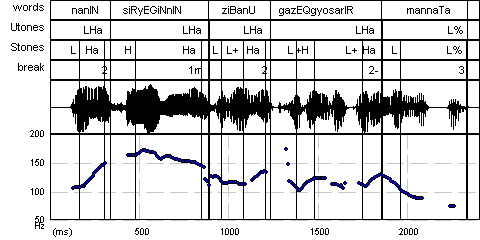
Pitch tracks and labels are made using PitchWorks
(Scicon). A word tier is labelled as 'words',
a phonological tone tier as 'Utones' and a phonetic tone tier as 'Stones', a
break index
tier as 'break', and a miscellaneous tier as 'misc'. The number given in each
graph
matches that in the main text.
In figures #1-4 below, the vertical line marking
the beginning of the last syllable, '-yo'
[jo], is drawn before the line marking the boundary tone or '>'. This is to
show the
difference in Fo rise timing between H% and LH% and between HL% and LHL%.
1. <<
boundary-H% >> 'Is that
so?'
2. << boundary-LH% >> 'Is that
so?'

3. <<
boundary-HL% >> 'Is that
so?' 4. << boundary-LHL% >> 'Is that so?'

5. << J3A2-HLH%
>> 'Who is eating tonight?'

6. <<
IPboundary-HL% >> 'Wind and the
Sun' 7. << IPboundary-LH% >> 'Second,'


8. <<
2syllAP-LHa >> 'I hate Younga'

9. << 5syllAP-LHLHa
>> 'Youngmi's family hates Younga'

10. <<
6syllAP-LHLHa >> 'Youngi's mom hates Younga'

11. <<
5syllAP-HHLHa >> 'Hyungmin's family hates Younga'

12. << t1p1s2
>>-early 'Among the two types which provide
motivation,'

13. << t1p2s8-1m
>> 'Being growing means that it is alive'
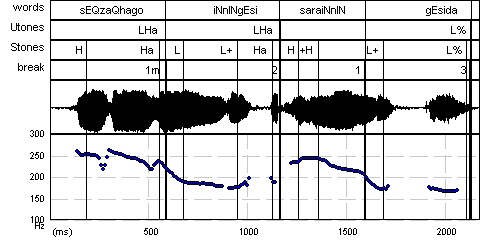
14. <<
gazEQgyosa >> 'I met the tutor of a powerful
family'
15. << t1p1s2
>>-late
'(Among the two types which provide motivation,) what's in common is
completeness'

16. <<
break-L8c3 >> 'When is Madam making (it)?'

17. << t1p2s6
>> 'That is, coral is alive and a rock is dead'
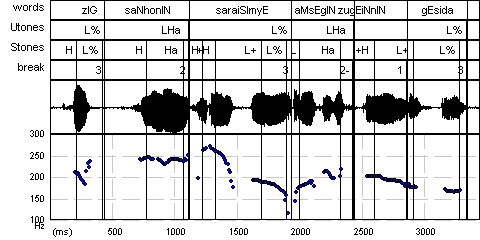
18. << t1p2s10
>> 'This also applies to our mind'

19. << t1p2s5
>>-early 'But, if you see a piece of coral under the
same microscope,...'

20. << t1p2s5
>>-late 'We can see that coral is changing while
growing'

21. <<
coQgaG-HLH% >>
'The man who is guarding firmly is the young
bachelor, Anthony Parkinson'


22. << millennium >>-early
'Thesedays,
that kind of church, eh, Year 2000, millennium....'

23. <<
millennium >>-middle
'Now, (it will) start from next year ... (Yes)'

24. <<
millennium >>-final 'They say, first of all, many
churches will change too (Yes)'

This version is
published in UCLA Working Papers in Phonetics 99. A slightly earlier
version (V. 3.0) is published in Speech Sciences, Vol.7, No.1
pp.143-170.
You can download this paper (in pdf ).
Links to the previous version of K-ToBI ( Version 2 )
Links to the ToBI homepage --
links to English ToBI and other ToBIs (German, Japanese, Greek, Serbo-Croatian,
Cantonese, Mandarin, Spanish, Taiwanese, English-Glasgow variety)
<= Back to Home